
この記事シリーズではAPの概要や各科目で要求される内容を紹介します。本記事はCalculus AB/BCに関してです。
なお、この記事はEffective Fall 2020に基づくもので、2026年5月の試験で有効なものです。公式な情報はCollege Boardのウエブサイトで確認してください。
- AP(Advanced Placement)とは
- カバーされる内容
- 1 Limits and Continuity
- 2 Differentiation: Definition and Basic Derivative Rules
- 3 Differentiation: Composite, Implicit, and Inverse Functions
- 4 Contextual Applications of Differentiation
- 5 Analytical Applications of Differentiation
- 6 Integration and Accumulation of Change
- 7 Differential Equations
- 8 Applications of Integration
- 9 Parametric Equations, Polar Coordinates, and Vector-Valued Functions
- 10 Infinite Sequences and Series
- 多肢選択式の試験
- 自由記述式の試験
- 最近の成績データ
- まとめ
AP(Advanced Placement)とは
AP(Advanced Placement Test)とは、米国のCollege Boardによって主催される試験です。約40科目が設定されており、好成績を獲得すると以下のようなメリットがあります。
(1) 英語圏大学のadmission processを有利に進めることができる
(2) 大学での単位の一部に認定してもらえることがある
(3) 大学レベルの知識があることが証明される
(1)について、米国ではSATがほぼ必須になっています。しかしSAT mathは基礎的な内容であり、世界中から優秀な志願者の集まる有名大学ではSATではほとんど差がつきません。
このとき、エッセイやinterviewで差がつき、またAPやIBなどの追加資料を提出することができれば、選考プロセスが有利になります。
(2)は大学ごとに異なりますが、大学1-2年の単位の一部をAPの試験の成績に応じて認定してもらえることがよくあります。
カバーされる内容
CalculusはABとBCという2種類があり、BCの方が出題範囲が広くなります。
日本の大学受験では数学IIIの「極限、微分法、積分法」あたりに相当しますが、そこに登場する三角関数は日本の教科書にないものが現れます。また微分法や積分法では日本の教科書の範囲外に及びます。
大学でScience、Engineering、Economy系を志願するのであればBCの受験をお勧めします。それ以外はABで問題ありません。また準備に時間をかけることができるなら、先にABを受験し翌年にBCを受験するということもできます。
1 Limits and Continuity
選択肢式試験において、ABでは全体の10-12%、BCでは4-7%を占めます。日本の「極限」や「関数の連続性」などの章がここに該当します。
Introducing Calculus: Can Change Occur at an Instant?
Defining Limits and Using Limit Notation
Estimating Limit Values from Graphs
Estimating Limit Values from Tables
Determining Limits Using Algebraic Properties of Limits
Determining Limits Using Algebraic Manipulation
Selecting Procedures for Determining Limits
Determining Limits Using the Squeeze Theorem
Connecting Multiple Representations of Limits
Exploring Types of Discontinuities
Defining Continuity at a Point
Confirming Continuity over an Interval
Removing Discontinuities
Connecting Infinite Limits and Vertical Asymptotes
Connecting Limits at Infinity and Horizontal Asymptotes
Working with the Intermediate Value Theorem (IVT)
2 Differentiation: Definition and Basic Derivative Rules
選択肢式試験において、ABでは全体の10-12%、BCでは4-7%を占めます。ほとんどが微分法の基礎的な計算手順に関する内容です。
Defining Average and Instantaneous Rates of Change at a Point
Defining the Derivative of a Function and Using Derivative Notation
Estimating Derivatives of a Function at a Point
Connecting Differentiability and Continuity: Determining When Derivatives Do and Do Not Exist
Applying the Power Rule
Derivative Rules: Constant, Sum, Difference, and Constant Multiple
Derivatives of $\cos{x}, \sin{x}, e^x$, and $\ln{x}$
The Product Rule
The Quotient Rule
Finding the Derivatives of Tangent, Cotangent, Secant, and/or Cosecant Functions
3 Differentiation: Composite, Implicit, and Inverse Functions
選択肢式試験において、ABでは全体の9-13%、BCでは4-7%を占めます。前章に続いて、合成関数、陰関数、逆関数、高階の微分などの計算手順に関する内容です。
The Chain Rule
Implicit Differentiation
Differentiating Inverse Functions
Differentiating Inverse Trigonometric Functions
Selecting Procedures for Calculating Derivatives
Calculating Higher-Order Derivatives
4 Contextual Applications of Differentiation
選択肢式試験において、ABでは全体の10-15%、BCでは6-9%を占めます。変化率の文章題で、点の運動(座標、速度、加速度)や接線の傾きを使った近似計算などが含まれます。
日本にはない「ロピタルの定理」も出てきます。
Interpreting the Meaning of the Derivative in Context
Straight-Line Motion: Connecting Position, Velocity, and Acceleration
Rates of Change in Applied Contexts Other Than Motion
Introduction to Related Rates
Solving Related Rates Problems
Approximating Values of a Function Using Local Linearity and Linearization
Using L’Hospital’s Rule for Determining Limits of Indeterminate Forms
5 Analytical Applications of Differentiation
選択肢式試験において、ABでは全体の15-18%、BCでは8-11%を占めます。平均値の定理、関数の増減や極値、グラフ、最適化問題などが含まれています。
Using the Mean Value Theorem
Extreme Value Theorem, Global Versus Local Extrema, and Critical Points
Determining Intervals on Which a Function Is Increasing or Decreasing
Using the First Derivative Test to Determine Relative(Local) Extrema
Using the Candidates Test to Determine Absolute (Global) Extrema
Determining Concavity of Functions over Their Domains
Using the Second Derivative Test to Determine Extrema
Sketching Graphs of Functions and Their Derivatives
Connecting a Function, Its First Derivative, and Its Second Derivative
Introduction to Optimization Problems
Solving Optimization Problems
Exploring Behaviors of Implicit Relations
6 Integration and Accumulation of Change
選択肢式試験において、ABでは全体の17-20%、BCでも17-20%を占めます。積分の意味、面積とリーマン和、導関数と不定積分のルール、置換積分などの計算方法が含まれます。
部分積分、部分分数への分解、広義積分はBCでのみ扱われます。ABでは範囲外です。
Exploring Accumulations of Change
Approximating Areas with Riemann Sums
Riemann Sums, Summation Notation, and Definite Integral Notation
The Fundamental Theorem of Calculus and Accumulation Functions
Interpreting the Behavior of Accumulation Functions Involving Area
Applying Properties of Definite Integrals
The Fundamental Theorem of Calculus and Definite Integrals
Finding Antiderivatives and Indefinite Integrals: Basic Rules and Notation
Integrating Using Substitution
Integrating Functions Using Long Division and Completing the Square
Integrating Using Integration by Parts*
Using Linear Partial Fractions*
Evaluating Improper Integrals*
Selecting Techniques for Antidifferentiation
*BC only
7 Differential Equations
選択肢式試験において、ABでは全体の6-12%、BCでは6-9%を占めます。微分方程式の基礎、slope field、変数分離法による一般解、初期条件を使った特殊解、指数関数でモデル化できる問題(文章題)などがカバーされます。
オイラー法による近似解、対数関数でモデル化できる問題はBCでのみ扱われます。
Modeling Situations with Differential Equations
Verifying Solutions for Differential Equations
Sketching Slope Fields
Reasoning Using Slope Fields
Approximating Solutions Using Euler’s Method*
Finding General Solutions Using Separation of Variables
Finding Particular Solutions Using Initial Conditions and Separation of Variables
Exponential Models with Differential Equations
Logistic Models with Differential Equations*
*BC only
8 Applications of Integration
選択肢式試験において、ABでは全体の10-15%、BCでは6-9%を占めます。動点の問題、面積、体積の問題などが含まれます。
曲線の長さを求める問題はBCでのみ扱われます。
Finding the Average Value of a Function on an Interval
Connecting Position, Velocity, and Acceleration of Functions Using Integrals
Using Accumulation Functions and Definite Integrals in Applied Contexts
Finding the Area Between Curves Expressed as Functions of x
Finding the Area Between Curves Expressed as Functions of y
Finding the Area Between Curves That Intersect at More Than Two Points
Volumes with Cross Sections: Squares and Rectangles
Volumes with Cross Sections: Triangles and Semicircles
Volume with Disc Method: Revolving Around the x- or y-Axis
Volume with Disc Method: Revolving Around Other Axes
Volume with Washer Method: Revolving Around the x- or y-Axis
Volume with Washer Method: Revolving Around Other Axes
The Arc Length of a Smooth, Planar Curve and Distance Traveled*
*BC only
9 Parametric Equations, Polar Coordinates, and Vector-Valued Functions
以下の内容はBCでのみ扱われるものです。選択肢式試験において11-12%を占めます。
媒介変数で表された関数の微分、ベクトル表示された関数の微積分、極座標表示された関数の微積分や面積の問題などが含まれています。
Defining and Differentiating Parametric Equations
Second Derivatives of Parametric Equations
Finding Arc Lengths of Curves Given by Parametric Equations
Defining and Differentiating Vector-Valued Functions
Integrating Vector-Valued Functions
Solving Motion Problems Using Parametric and Vector-Valued Functions
Defining Polar Coordinates and Differentiating in Polar Form
Find the Area of a Polar Region or the Area Bounded by a Single Polar Curve
Finding the Area of the Region Bounded by Two Polar Curves
10 Infinite Sequences and Series
以下の内容はBCでのみ扱われるものです。選択肢式試験において17-18%を占めます。
無限級数の収束判定、等比級数、テイラー級数とマクローリン級数、打切り誤差、収束半径などが含まれています。ほとんどが日本の高校数学の範囲外です。
Defining Convergent and Divergent Infinite Series
Working with Geometric Series
The nth Term Test for Divergence
Integral Test for Convergence
Harmonic Series and p-Series
Comparison Tests for Convergence
Alternating Series Test for Convergence
Ratio Test for Convergence
Determining Absolute or Conditional Convergence
Alternating Series Error Bound
Finding Taylor Polynomial Approximations of Functions
Lagrange Error Bound
Radius and Interval of Convergence of Power Series
Finding Taylor or Maclaurin Series for a Function
Representing Functions as Power Series
多肢選択式の試験
試験全体は多肢選択と自由記述が50%ずつです。
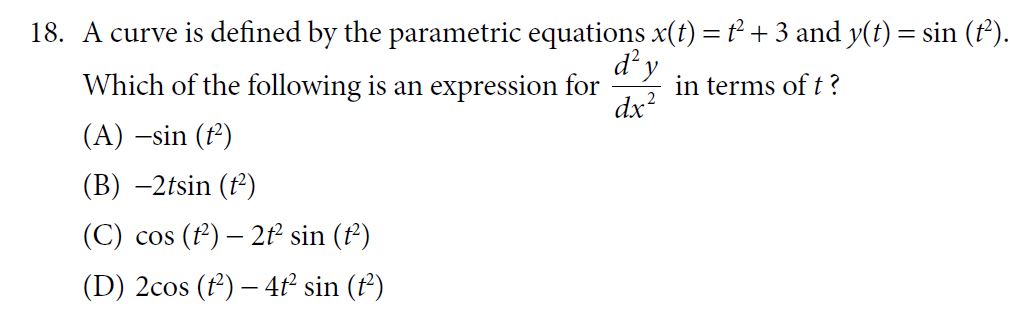
多肢選択はほぼ4択で、計算機を使えないパートが30問で60分、計算機を必要とするパートが15問で45分です。計算機なしの方は1問あたり2分、計算機ありの方は1問3分ありますが計算機の操作のことを考えれば次回は非常に限られています。どちらのパートもスピードと正確さが要求されます。
↓試験問題のサンプルです。
自由記述式の試験
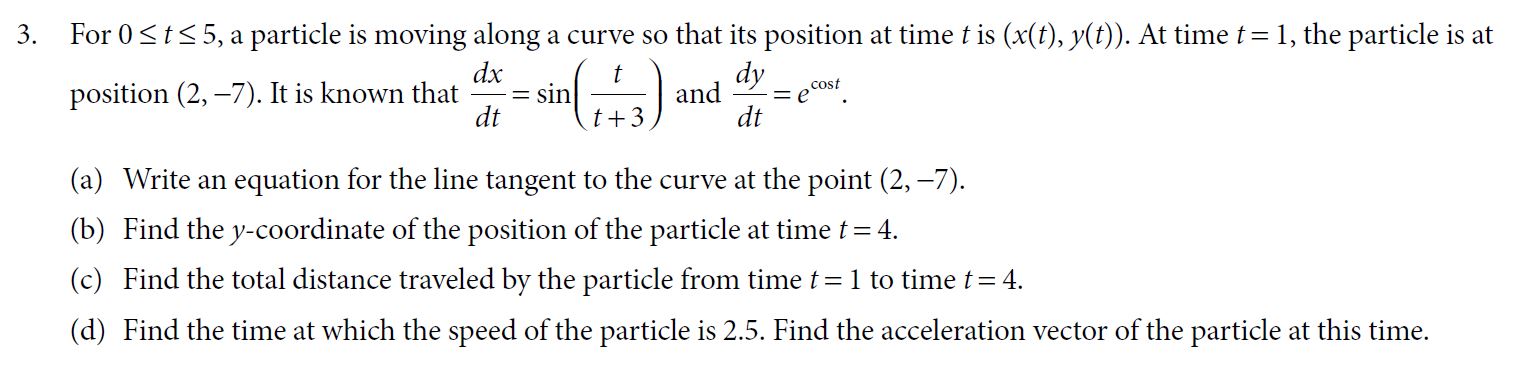
自由記述は大問6問で構成されており、計算機を必要とするパートが2問で30分、計算機不可のパートが4問で60分です。
単に計算して答を出すだけでなく、結論に至るまでの過程を論理的に記述したり、文章での記述が要求される設問もあります。
↓試験問題のサンプルです。
最近の成績データ
過去の詳細なデータはCollege Boardのウエブサイトで公表されています。
2024年のcalculus ABでは、総受験者数が278,657人、”5″の獲得者数は59,569人で、受験者の21.4%となっています。またBCでは、総受験者数が148,191人、”5″の獲得者数は70,723人で、受験者の47.7%となっています。
BCで”5″の獲得者が多いのは、試験が易しいという意味ではありません。BCを受験するような受験生は既に大学レベルの数学をマスターしていることが多いのです。BCは大学の理系学部でも数学の単位の一部に読み替えられることから、そういう受験生が多く受験しているというだけのことであり、微積分が未習の状態からスタートするなら1-2年の準備が必要です。
まとめ
Calculusでは日本の数学IIIで学ぶ極限と微積分に相当するところがほぼすべて含まれています。さらに微分方程式の初歩やBCでは級数展開と収束判定なども含まれていて、これらは日本の標準的な高校数学のカリキュラムには含まれていません。
三角関数も、日本のカリキュラムでは$\sin\theta$、$\cos\theta$、$\tan\theta$だけですが、calculusでは$\csc\theta$、$\sec\theta$、$\cot\theta$、$\arcsin\theta$、$\arccos\theta$、$\arctan\theta$まで含まれており、それらの微積分も問われます。
多肢選択式の問題は制限時間が厳しいので短時間でどんどん正解を出していく必要があります。
自由記述式の試験問題は、計算して答を出すだけではなく採点基準をクリアーした記述をしなくては得点にならないので、こちらは専用に対策が必要です。
公式な情報はCollege Boardや志願先大学の公式ウエブサイトで確認してください。
65学院ではAP Calculus AB/BC受験に向けた個別指導をおこなっています。詳しくはお問い合わせください。

コメント